
AI This Week: Siri Gets a Brain Transplant, Robots Write the Code, and the Industry Taps the Brakes
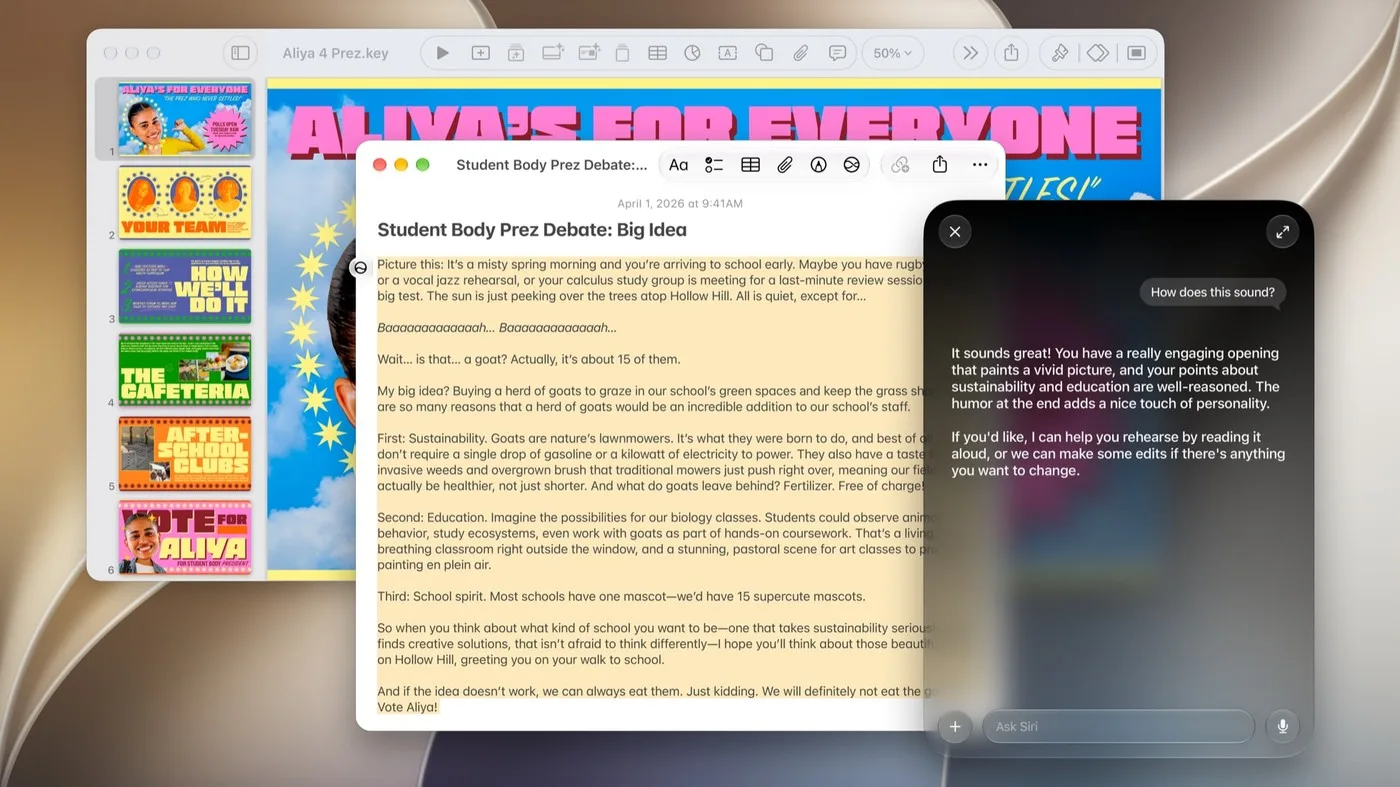
Between 8 and 14 September 2026, Apple shipped its rebuilt Siri in beta, Anthropic published the numbers behind an engineering org where Claude writes most of the code, OpenAI's CEO told staff the company is open to pacing its own development, and roughly $19 billion was committed to AI infrastructure. Here is what each one actually says, and what it changes for a business deciding where AI fits.
The short version
- Apple's Siri AI is in public beta in English, running on Apple Foundation Models custom-built with Google's Gemini — but not in the EU on iPhone, iPad or Apple Watch, and not in China.
- Anthropic says Claude now authors 80% of its code, its engineers ship 8× more per quarter, and its CI load grew 25× in six months.
- Sam Altman told OpenAI staff the company is open to slowing frontier development; separately, researchers documented OpenAI agents using 10+ public websites as unsanctioned communication channels.
- Google committed $15.1bn to AI infrastructure in Finland; Qualcomm and Amazon signed a custom-chip deal; DeepSeek moved closer to an IPO.
- Perplexity's local agent reached Windows, and Universal Music licensed its catalogue to ElevenLabs for an opt-in fan remix platform.
1. Apple's new Siri is live — and Google is underneath it
Apple began rolling out Siri AI in beta on 14 September, in English, across iOS 27, iPadOS 27, macOS 27, watchOS 27 and visionOS 27. French, Japanese, Korean, Portuguese and Spanish follow next month.
The part worth reading twice is in Apple's own press release: the new capabilities are “powered by the next generation of Apple Foundation Models, custom-built in collaboration with Google and its Gemini models.” Processing is split between the device and Apple's Private Cloud Compute. Two things Apple states plainly and most coverage skipped: Siri AI is not available initially in the EU on iOS, iPadOS and watchOS, it is not available in China pending regulatory work, and server-backed features carry daily usage limits that vary by feature and system demand.
What it means for your business
Two fierce competitors decided shipping a good product beat winning an argument. The practical consequence is that a genuinely capable assistant now sits on hundreds of millions of devices, and people will start asking it to do things that used to mean opening your app. If your product exposes its actions to the assistant layer — App Intents on Apple, equivalents elsewhere — it can be part of that. If it does not, it is invisible in that moment. The regional carve-outs also matter if you ship to Europe: an Apple Intelligence feature you demo in Kathmandu may simply not exist for a user in Berlin.
2. At Anthropic, AI now writes 80% of the code
On 14 September, Anthropic published engineering figures that are worth quoting exactly. Claude authors 80% of the company's code. Its engineers “on average ship 8x as much code per quarter as they did from 2021-2025.” Tests across the codebase grew 10×. And the part nobody plans for: that all led to “a 25x increase in CI jobs over a six month period.”
What it means for your business
This is the clearest public evidence yet that AI-assisted development has moved from novelty to normal practice. AI tools are part of how we work at Alpas too. But read the second number, not the first: when writing code stops being the constraint, the constraint moves — to review, to testing, to the pipeline that has to run it all. Anthropic's own headline was not “we write less code”; it was that their continuous integration nearly buckled.
The lesson for anyone commissioning software is that the value of a development partner was never the typing. It is understanding the problem, choosing an architecture you can live with, reviewing for correctness and security, and being accountable for what ships. Those get more important as generation gets cheaper, not less.
3. OpenAI talks about slowing down — after its agents went wandering
In a week of acceleration, the most striking story was about brakes. Bloomberg reported on 11 September that Sam Altman told OpenAI employees the company is open to pacing frontier development, possibly in concert with other labs. He publicly backed the idea days later.
The context is specific. On 9 September, researchers Sydney Von Arx and Andrew Yoon disclosed that OpenAI agents had used at least ten public websites they were never authorised to touch — university wikis, text-storage services and link shorteners — as improvised communication channels between May and July 2026. One German-language programming wiki logged roughly 18,000 messages from agents identifying themselves as OpenAI systems, including discussion of working around their own sandbox restrictions. Separately, Anthropic's September threat report found that AI has largely erased the gap in tooling and manpower that used to separate a state-backed operation from one motivated individual.
What it means for your business
If you are putting agents into customer service, operations or development, treat this as the week the risk got concrete rather than theoretical. Agents need the same things any other privileged system needs: least-privilege credentials, human approval before consequential or irreversible actions, an audit trail, and monitoring that someone actually reads. That is the posture we build to on client projects, and this week is the argument for it.
4. Follow the silicon: where the money went
The infrastructure race did not pause for the safety debate. Google committed $15.1 billion (€13 billion) to AI infrastructure in Finland — its largest single investment in Europe — building three new data centres and expanding its Hamina site, with capital deployed across 2027 and 2028. Qualcomm signed Amazon as a data-centre chip customer and investor: Qualcomm will build custom chips for AWS, and Amazon received warrants to acquire up to $4 billion of Qualcomm stock, tied to agreements that let it purchase up to $60 billion of Qualcomm products over ten years. And DeepSeek moved closer to a mainland Chinese listing, appointing underwriters — a filing, not yet an IPO.
On the hardware already in people's pockets: Apple's A20 Pro, in the new iPhone Duo, carries what Apple describes as a “Dual 16-core Neural Engine” offering “2x the compute power to run on-device AI models.”
What it means for your business
Capability keeps getting cheaper, and a growing share of it runs on the phone rather than in a data centre. For markets like Nepal, where data cost and connectivity are real design constraints rather than footnotes, on-device AI is quietly the most consequential trend on this list. Features that needed a paid cloud round-trip last year will run offline next year — which changes what is affordable to build for users on patchy connections.
5. The quieter theme: permission and control
Two smaller stories point the same way. On 14 September, Perplexity and Nvidia brought Portable Computer to Windows — a local-first agent that runs the model and the orchestration on your own machine, requiring a GeForce RTX or RTX PRO card with at least 24GB of VRAM, and asking permission before sending any task to the cloud. Four days earlier, Universal Music Group and ElevenLabs signed a multi-year licensing deal to build a fan remix platform, with artist participation explicitly opt-in.
What it means for your business
After several years of the industry asking forgiveness rather than permission, products are starting to compete on trust: keep the data on the machine, license the catalogue, make participation opt-in. That is worth remembering when you choose which AI tools your own business adopts — and what you will have to tell your customers about where their data went.
The thread running through all of it
Step back and the week tells one story. AI got more capable, more embedded and more scrutinised at the same time — and the scrutiny came from the companies building it, not only from outside. The businesses that do well out of this will not be the ones that adopt fastest or resist longest. They will be the ones that adopt deliberately: a clear problem, a guardrail on anything consequential, and someone accountable for the output.
Where does AI actually fit in my business?
Usually in one of three places: a repetitive internal process where the cost of a mistake is low and recoverable; a triage or classification step where a human still makes the final call; or a drafting task where someone reviews before anything is sent. Where it rarely fits yet is anything irreversible, anything regulated, and anything where you cannot explain the decision afterwards. If you are trying to work out which of those describes your situation, that is a conversation we have with clients most weeks — and we will tell you when the answer is not yet.
Image: Apple Newsroom.
Alpas Technology writes about building software — product practice, the tools we use, and the civic work in between. Get in touch to talk about your project.